26-foot box truck on Relay in Ontario: CVOR, IFTA and IRP
Which weight and axle limits put an Ontario box truck under CVOR, IRP and IFTA, and what changes when a Relay load goes to Quebec or the US.
By Manpreet Singh October 27, 2026 5 min read
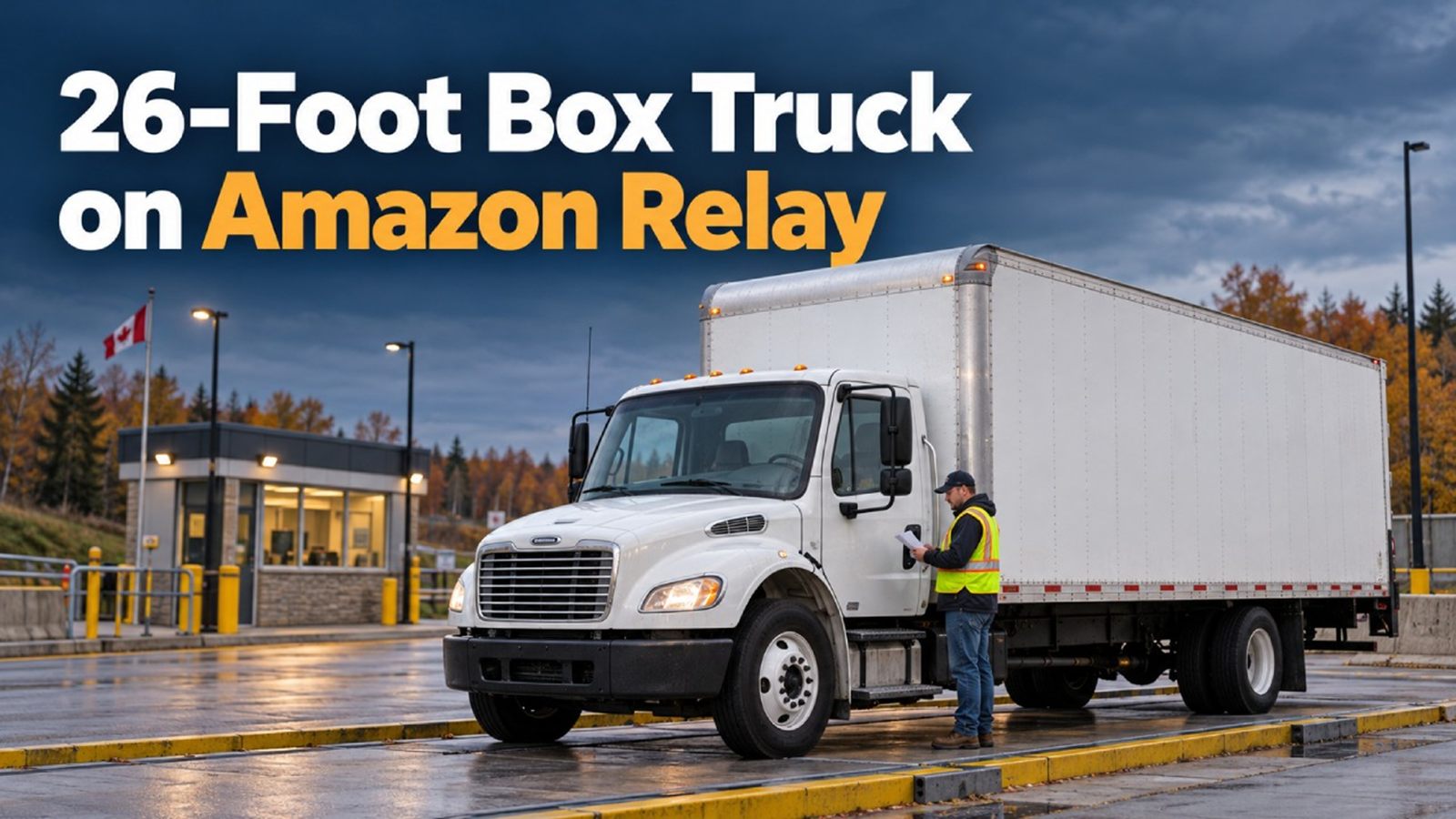
Plating a two-axle box truck at 13,000 kg cost Sukhdeep a Relay load to Montreal. Sukhdeep is a hypothetical carrier, a composite. He bought a used 26-footer in Brampton in the spring and gave ServiceOntario 13,000 kg as its registered gross weight. Four months later the Montreal load came up on the board. He had no apportioned plate, no IFTA licence and no trip permits, so the load went to someone else.
The one registration he had right was his CVOR. Ontario requires a CVOR certificate for trucks with a registered gross weight or actual weight over 4,500 kg, and at 13,000 kg registered he was nearly three times over that line. A lot of people half-remember an exemption for rentals. The one on that page is narrow: a truck leased by an individual for 30 days or less to move personal goods. A rented box truck hauling Relay freight doesn't fit it, so whoever rents one for that work needs a CVOR of their own.
For those first four months his work stayed in Ontario: Brampton to Ottawa, Brampton to London, the 401 and the 416. Ontario's IRP page is written for carriers who plan to travel outside the province, and the Ministry of Finance's IFTA carriers manual says a carrier based in Ontario who travels only in Ontario needs no IFTA licence and files no reporting. As long as he stayed home, neither program touched him. That changes once the decals go on. The same manual says a licensed carrier reports all travel of the truck for as long as the decals are in effect, so a week spent entirely in Ontario still goes on the quarterly return.
When the Montreal load came up, he read both pages properly. For IRP, Ontario says carriers leaving the province should register vehicles with gross weights over 11,793 kg or with three or more axles, and Ontario's IRP carrier manual says that for a two-axle truck either number counts, actual gross weight or registered. His 13,000 kg plate put him in on paper, even on days the box was half empty. IFTA has its own test. The manual counts a two-axle truck whose actual or registered gross weight is over 11,797 kg, a truck with three or more axles on the power unit at any weight, and a truck pulling a trailer when the combination's total actual or registered gross weight is over 11,797 kg. Both figures stand for 26,000 lb, four kilos apart on two different pages; go by the one for the program you're checking. At 13,000 kg he was over both.
For his truck at that weight, every run into a province or state that required registration meant a trip permit until he joined IRP. Ontario's IRP page says that if you plan more than 12 trips outside the province, registering usually costs less than buying single trip permits. IFTA works the same way: the Ministry of Finance says a qualified vehicle without a valid licence needs a single trip permit before any interjurisdictional travel. Crossing a border doesn't put every truck in that spot. The SAAQ says certain vehicles registered outside Québec can run on its roads without Quebec registration, with the exemption depending on the type of vehicle and its owner. What a given truck needs comes from its weight, its axles and the rules where it's going.
He didn't just write down a smaller number. Ontario's CVOR page says it's illegal to run a vehicle heavier than its registered gross weight, and it points to certain truck stops and municipal facilities with public scales for weighing. His heaviest Relay load so far, with him in the cab and a full tank, came to 10,400 kg. He went back to ServiceOntario and re-plated at 11,700 kg, which is also the figure the province uses to work out his registration fees.
That 11,700 kg plate keeps him under the IRP and IFTA lines only as long as every load keeps the truck under 11,700 kg. One scale ticket at 10,400 kg tells you about that load and nothing about next month's. Actual weight is part of both tests, so a heavy load that took the truck past 11,793 kg would put him over the IRP line on that trip, whatever the plate said, and over his own registered weight, which is an offence by itself. A third axle or a trailer would change the answer too.
The lower plate doesn't change his licence. Ontario's truck handbook puts any motor vehicle over 11,000 kg gross weight or registered gross weight in Class D, so at 11,700 kg registered he needs a D licence even on days the truck scales well under that. If the truck has air brakes or air-over-hydraulic brakes, Ontario's air brake handbook says he needs the Z endorsement as well.
He took the next Montreal load, east on the 401 and onto the 20. With two axles, 11,700 kg on the plate and a scale weight under that, he kept his Ontario plate, needed no cab card and no IFTA decals, and still had to keep his CVOR in order. He kept every fuel receipt anyway, with the kilometres in each province written down, because the gap between needing IFTA and not is a few hundred kilos of freight. How fuel tax works out on runs like that is worth one conversation with your accountant or Ontario's Ministry of Finance before the first trip.
Later that week a load to a building outside Buffalo showed up. IRP covers states as well as provinces, and IFTA covers all its member jurisdictions, so the weight and axle lines are the same at the Peace Bridge as at the Quebec border. Crossing into the US also brings customs and US operating authority, which sit outside these three registrations, and he passed on the load until he'd sorted those out.
A 26-foot box truck that never leaves Ontario needs a CVOR from this list and nothing else. Once it crosses a border, the answer depends on the axle count, the plate weight, what the truck actually weighs loaded and whether a trailer is behind it. Of those, the plate weight is the one a carrier picks at a counter, and it should come from the heaviest load you expect to haul, with a scale ticket to back it.
About the author
Manpreet Singh
Works with small trucking fleets at ZyloFuel, a Canadian fuel card company for owner-operators and fleets of up to twenty trucks.