Getting on Amazon Relay in Canada: what you need before you apply
What Amazon Relay asks of Canadian carriers: NSC number, insurance limits in CAD, equipment and driver setup, and how it differs from US guides.
By Manpreet Singh October 28, 2026 4 min read
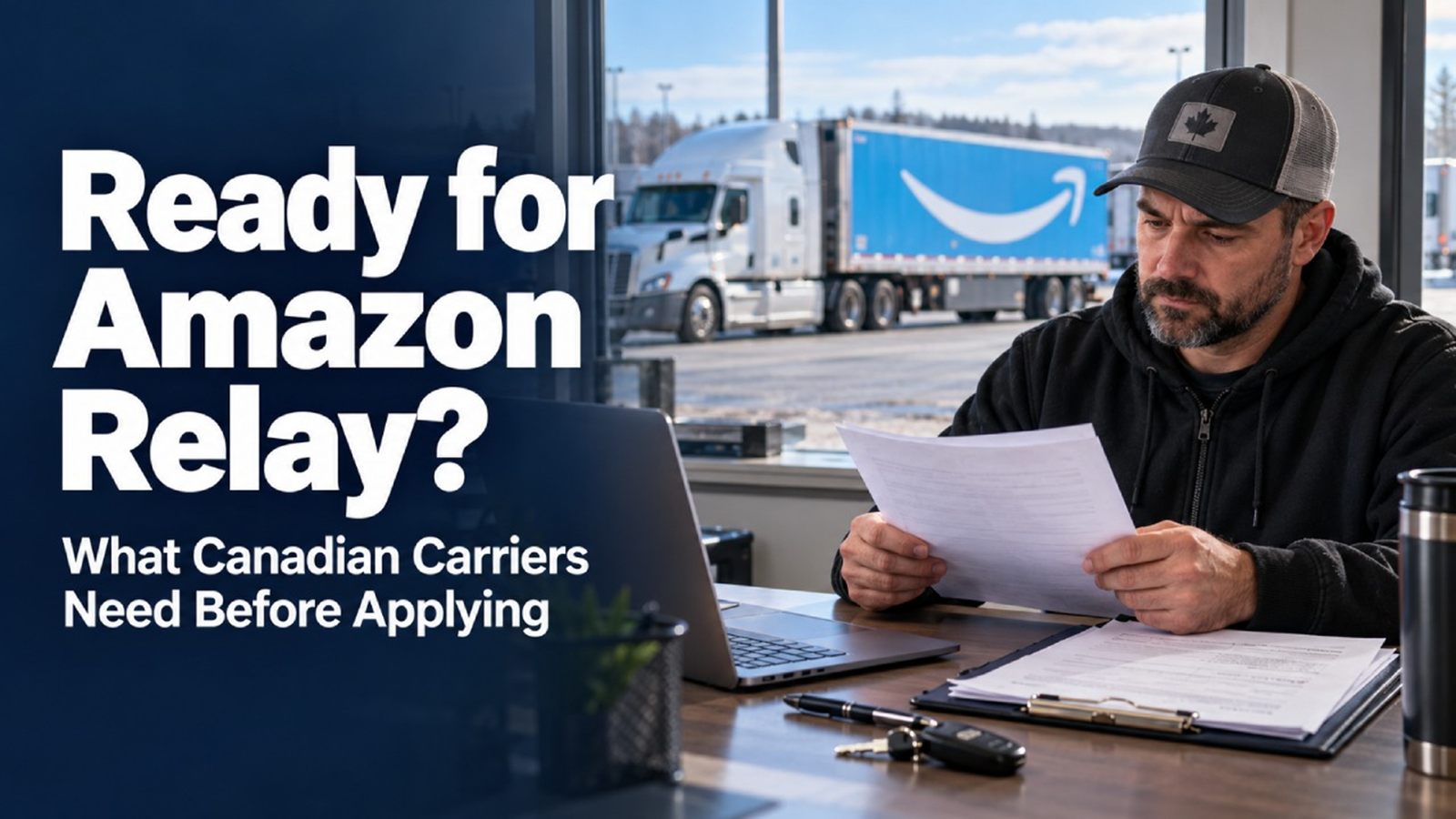
Once Amazon has a completed application on relay.amazon.ca, it says it will approve or reject it within two to four business days, and the only cause of delay it names is checking your insurance. That leaves very little time to fix anything after you apply, so do the work before. Most Relay guides a Canadian carrier finds online describe the American program. That one asks for numbers and scores a fleet running only in Canada doesn't have and doesn't need.
Canadian carriers apply on their own site, relay.amazon.ca, and you sign in there with an amazon.ca account. Read the requirements on the Canadian page, because those are the ones that apply to you. Here they are in the order you'll run into them.
Authority: the NSC number, plus US numbers if you cross
For freight that stays inside Canada, Amazon's Canadian FAQ asks for one thing: an active National Safety Code number. It doesn't ask for a DOT number or an MC number, and it doesn't mention FMCSA scores.
For cross-border loads the list gets longer. You need an active NSC number, a DOT number with interstate authority and a valid MC number. Your FMCSA entity type has to be "Carrier", authorized for property and for hire, and your FMCSA safety rating has to be Satisfactory, None or Not Rated.
The US program asks for more again. Its get-started page wants the DOT number active for at least 180 days. Your BASIC percentiles have to be under set limits: Unsafe Driving and HOS Compliance below 60%, and Vehicle Maintenance, Controlled Substances/Alcohol and Driver Fitness below 75%. On top of that, Amazon works out violation rates from the past 12 months of FMCSA inspections. The driver violation rate has to be at or below 35% and the vehicle violation rate at or below 50%. The Canadian FAQ doesn't say whether the 180-day rule and these safety limits apply to a Canadian carrier applying for cross-border work. If you're counting on US loads with a newly issued DOT number, ask Relay first.
For an Ontario carrier, your safety standing lives on your CVOR record. The Canadian page sets no rating threshold for it, the way the cross-border section does for FMCSA. What Amazon does say is that it uses its own compliance teams and a third-party compliance monitoring service to check carriers and keep watching them. It doesn't say what that service looks at for a Canadian carrier. If your CVOR record has problems, assume someone will see them.
The insurance list, in Canadian dollars
Every limit on the Canadian page is in CAD. That matters when you compare it with US guides that quote the same figures in American dollars. Commercial general liability has to be at least $1,000,000 per occurrence and $2,000,000 aggregate. Auto liability has to be at least $1,000,000 per occurrence and include $50,000 of trailer replacement coverage. Cargo coverage has to be at least $150,000, and employer liability at least $100,000 per occurrence.
Workers' compensation is the line that catches people. Amazon wants it in every jurisdiction where your company operates. If you operate in Quebec, it also wants you registered with the CNESST, and that covers an Ontario fleet running a few loads a month into Montreal. The page doesn't say how the workers' comp line applies to an owner-operator with no employees, and provinces don't all treat that case the same way. Put the question to your broker and to Relay. Don't guess.
Equipment and drivers
The Canadian FAQ lists day cab and sleeper cab tractors, 53-foot dry vans and 26-foot box trucks. Reefers aren't on the list. Amazon's US FAQ requires a working tuck-under lift gate on a 26-foot box truck. The Canadian FAQ doesn't say either way. A box truck is a big purchase or a long rental, so before you sign for one, ask Relay what equipment it needs from you.
Drivers are set up in the Relay app, on Android or iOS, and Amazon requires every Amazon load to run through its Relay products. On the US Relay site, the carrier invites each driver to create a profile. The driver then verifies their identity with a selfie and a photo of their driver's licence, and gives details to start a background check, which every driver onboarding in the US has to pass before hauling a load. The Canadian FAQ doesn't mention a background check at all. It doesn't say whether Canadian drivers get one or what information they'd be asked for. Ask Relay how it works for your drivers before you plan a start date around them.
The Canadian page adds a step for owners. Amazon may ask a company's beneficial owners for a photo and take a scan of their face from that photo and from their ID. It uses the scan to make sure nobody else is using their login, and to deal with fraud and theft. It says it will ask for consent before it collects the scan. The two are kept for different lengths of time. The facial scan is kept for up to 30 days after it's made, or longer if Amazon needs it for fraud work or the law requires it. The photos are kept while your company hauls for Amazon, and after that for as long as the law allows.
Plan for the pay schedule too. Relay's pay week runs Sunday to Saturday, and loads finished by 23:59 on Saturday are paid on the Friday of the following week. Amazon generates the invoices, and you can raise a payment dispute through the portal within 30 days of reviewing your weekly invoice.
Before you open the application, call your insurance broker. Ask for a certificate that shows each of the limits above in Canadian dollars, with workers' compensation for every province you run in. Amazon itself says insurance is what holds these applications up.
About the author
Manpreet Singh
Works with small trucking fleets at ZyloFuel, a Canadian fuel card company for owner-operators and fleets of up to twenty trucks.