Relay rate per kilometre: count the deadhead before you book
A $1,600 Milton to Montreal load looks like $2.71 a km loaded, but with 335 km of deadhead it pays $1.73 a km and runs $44.65 short of costs
By Manpreet Singh October 27, 2026 6 min read
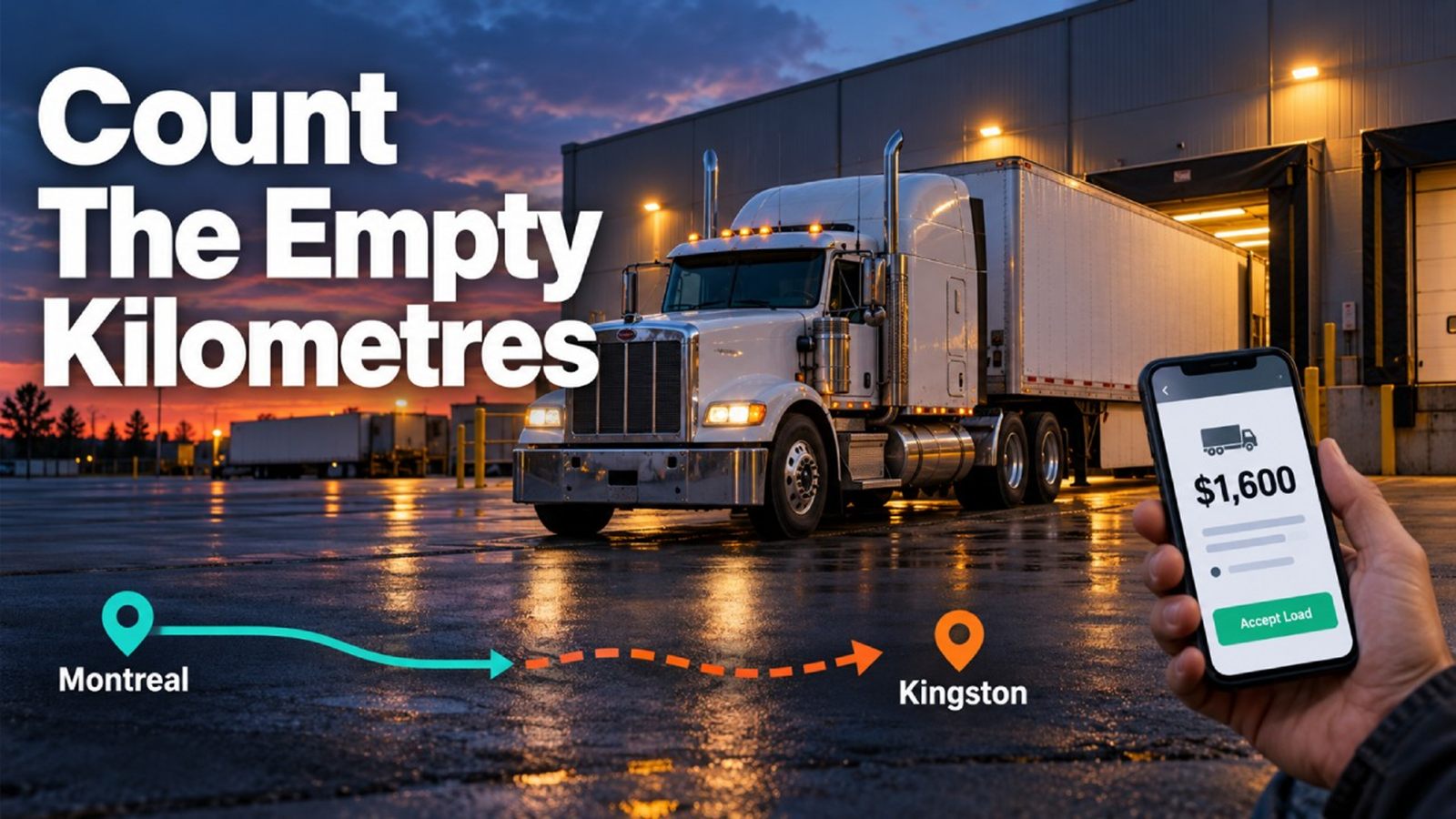
Divide a Relay rate by the loaded kilometres and a $1,600 load from Milton to Montreal looks like $2.71 a kilometre. Add the drive to the dock and the drive from the drop to the next load, and the same $1,600 comes to $1.73 a kilometre. For the carrier in the example below, that leaves almost no room for delays or unexpected costs. The load and the carrier are made up. The arithmetic is the same sum anyone can do on a phone before booking.
One load, every kilometre counted
The carrier is an owner-operator parked in Cambridge, Ont. The load picks up at a facility in Milton, delivers in Montreal and is posted at $1,600. Nothing is booked out of Montreal, and the closest load worth having is in Kingston.
All amounts are in Canadian dollars. The $1,600 is freight revenue before GST/HST. The carrier is registered for GST/HST and can fully recover the GST/HST on the business expenses in this example through input tax credits. For the profitability calculation, costs therefore exclude recoverable GST/HST. Assume all the trip's diesel is bought in Ontario.
The yard to the pickup is about 45 km. Milton to Montreal is about 590 km loaded, and Montreal back to Kingston is about 290 km empty. The truck turns its wheels for 925 km to earn this $1,600, and only 590 of those kilometres are loaded. These are illustrative distances; use the actual pickup, delivery and next-load locations when pricing your own trip.
| Leg | Km | Loaded |
|---|---|---|
| Cambridge to Milton (to the pickup) | 45 | No |
| Milton to Montreal (loaded) | 590 | Yes |
| Montreal to Kingston (to the next load) | 290 | No |
| Total | 925 |
$1,600 ÷ 590 = $2.71 per loaded kilometre. $1,600 ÷ 925 = $1.73 per total kilometre. The second figure is the one to hold against your costs, because the truck burns fuel and wears tires on all 925 km. If you take the loaded figure and hold it up against an all-in cost per kilometre, the load looks like it pays nearly a dollar a kilometre more than it does.
Some carriers split the empty run back to Kingston between this load and the next one. That's fine, as long as every empty kilometre ends up on one load's sums or the other and none is counted twice.
Fuel comes next. In this example, the carrier's ECM shows the truck averaging 36 litres per 100 km over the last few months. For the price, GlobalPetrolPrices has Ontario diesel averaging $2.30 a litre from 13 July to 19 October 2026. The low in that period was $1.97 and the high was $2.58, on 21 September. These are tax-inclusive pump prices. If you have the price you actually paid at your last few fills, use that. It'll be closer than any average.
925 km × 0.36 = 333 litres, and 333 × $2.30 = $765.90 paid for fuel. That is the cash outlay, including Ontario's 13% HST. Because this carrier can recover that HST, the fuel expense for this calculation is $765.90 ÷ 1.13 = $677.79, or about 73 cents a kilometre. The difference, $88.11, is recoverable HST. CRA explains input tax credits for freight carriers here.
At the September high of $2.58, the same 333 litres would cost $859.14 at the pump, or $760.30 after removing recoverable HST. That is $82.51 more in fuel expense on one load. At the $2.30 pump price used in this example, $1,600 − $677.79 leaves $922.21 after fuel, or about $1.00 for each of the 925 km.
Then everything else. Say the carrier's books show 95 cents a kilometre for everything except fuel, excluding recoverable GST/HST. That covers depreciation and loan interest, or lease payments, plus insurance, maintenance, tires, plates and permits, and an allowance for the owner's labour. 925 × $0.95 = $878.75. With fuel added, the trip's allocated costs are $1,556.54, leaving $43.46 from the $1,600 load. That's less than five cents a kilometre, before any net IFTA adjustment and any extra cost caused by the three hours the carrier expects to wait at the Milton door.
Waiting may not be fully captured by an average per-kilometre cost. An extra delay can add labour and idling costs and make the next pickup harder to reach. Loading waits generally count as on-duty time and can reduce the remaining driving opportunity under the applicable on-duty and elapsed-time limits. Read what the load says about detention before you book. If the first few hours aren't paid, allow for any waiting costs that are not already included in your figures.
Now change one thing. If a reload were waiting at the same facility in Montreal, with no further positioning distance, the trip would be 635 km and the rate would work out to $2.52 a kilometre. Fuel expense after removing recoverable HST would be 635 × 0.36 × $2.30 ÷ 1.13 = $465.29, and the other costs would be 635 × $0.95 = $603.25. That leaves $531.46 over allocated costs on the same $1,600, before any net IFTA adjustment or extra waiting costs. The empty run out of Montreal is what eats almost all of that margin.
Don't count fuel tax twice
The $2.30 pump price already includes the applicable federal and provincial fuel taxes, as well as HST. Removing recoverable HST does not remove the fuel taxes included in the price. If you add those same fuel taxes again as a separate expense, you count them twice. An IFTA adjustment is different: it reconciles eligible motor fuel tax already paid with the tax due on fuel consumed in each jurisdiction.
For illustration, assume about 130 of this trip's 925 km are in Quebec. Use your actual jurisdiction distances in your records. The quarterly IFTA return uses taxable distance by jurisdiction and the reporting fleet's quarterly average fuel economy to calculate taxable litres. Eligible tax-paid fuel purchases generate credits, and those credits are reconciled against the motor fuel tax due in the jurisdictions where you travelled. Depending on the purchases, consumption and rates for that quarter, the return can produce an additional payment or a credit. It does not mean adding the full Quebec fuel tax on top of all the tax already paid in Ontario.
Over a quarter of cross-border runs, those adjustments add up. The IFTA calculator on our free tools page (an Excel sheet) will help you work through the numbers from your own trip and fuel logs. For filing requirements and the amount actually due, check with your accountant or, for an Ontario-based carrier, the Ontario Ministry of Finance.
Before the next booking, work out the number all of this depends on. Take last quarter's costs other than fuel, excluding recoverable GST/HST, and divide them by every kilometre the truck ran, loaded and empty. Your IFTA distance records can help establish that total. Keep the figure where you'll see it when a load comes up. Add your fuel expense per kilometre on the same tax basis, then multiply by the trip's total kilometres. Allow for the estimated net IFTA adjustment and any extra waiting or trip costs not already included. That gives you an all-in break-even target under those assumptions. Add your desired profit margin when deciding what rate to accept.
About the author
Manpreet Singh
Works with small trucking fleets at ZyloFuel, a Canadian fuel card company for owner-operators and fleets of up to twenty trucks.