Fix or replace your old tractor: cost per kilometre, worked out
Put an aging tractor and a new one on cents per kilometre: repairs, downtime, fuel, payment, insurance and resale, and find where keeping it stops paying.
By Manpreet Singh October 24, 2026 6 min read
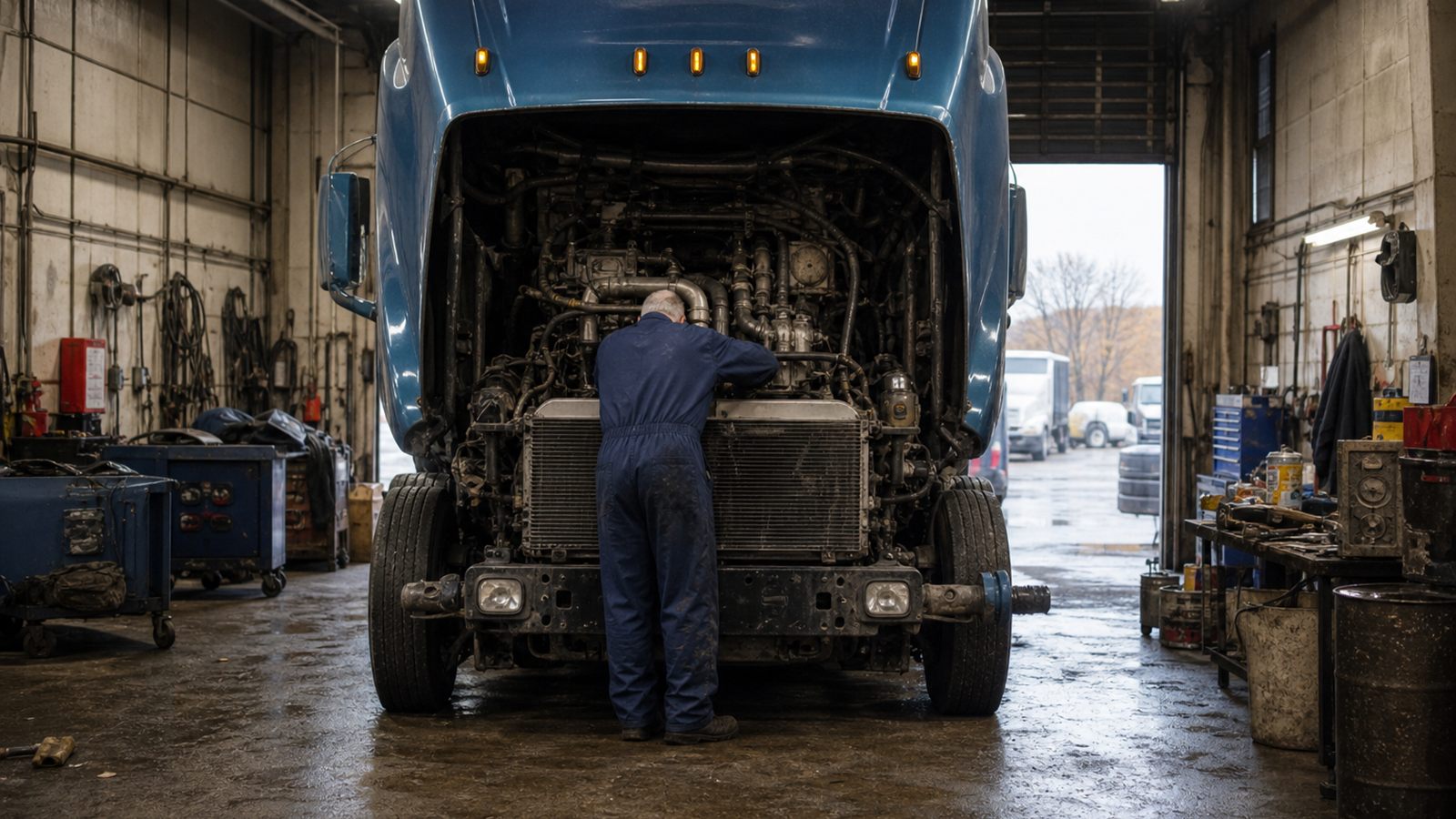
It's a Tuesday afternoon, and the service writer at a shop off the 401 in Milton is reading you the estimate on your 2015. It needs injectors and a turbo actuator, and he thinks the DPF is due. That's the third bill like it since spring. The dealer's quote for a new tractor has been sitting in your email for two weeks.
You can compare those two pieces of paper directly. Every cost either truck carries, from the shop bill to the loan payment, can be turned into cents per kilometre. Once it is, you can see whether the old truck is still the cheaper one to run, and how far it is from the point where it stops being cheaper.
This decision mostly comes up for owner-operators and small fleets running a tractor that's 8 to 12 years old and paid off, or close to it. Two things decide it: how many kilometres you run in a year, and how much payment your cash can carry through a slow quarter.
Five lines, each in cents per kilometre
Start with repairs on the old truck. Pull 24 months of invoices, including everything the shop charged plus roadside calls, and divide by the kilometres driven in the same period. Leave tires out, since either truck wears them. One year on its own can mislead you in either direction. For scale, the American Transportation Research Institute's 2025 cost survey put average repair and maintenance at 21.5 US cents a mile (Truckinginfo's report). That's for US fleets whose trucks averaged 3.6 years old. Among truckload carriers, fleets with fewer than five trucks had the highest repair costs. A ten-year-old tractor running well above that average is normal.
Downtime is the line most people skip. Count the days the truck sat in a shop or waited for parts. Multiply them by what a day of running nets you after fuel and the other costs that stop when the wheels stop, then add the tows. If a breakdown cost you a customer's lane, that belongs here too, though only you can put a number on it.
Fuel comes from your own records. Your IFTA records already hold litres and kilometres for each truck by quarter, so your real L/100 km is one division away. For the new truck, ask the dealer for figures from the same spec doing similar work, and treat them as the best case. Mack Trucks North America president Jonathan Randall told trucknews.com in October 2026 that Mack's engine built to the EPA 2027 NOx standard should get about 3% better fuel economy. That 3% is measured against Mack's present engine, so it comes on top of whatever gap already exists between your 2015 and a new truck.
Ownership is where the comparison usually gets muddled. The loan payment is cash out the door, but part of it buys you equity. The real cost of owning the new truck over the loan term is the price, plus total interest, minus what the truck will fetch at the end. Spread that over the kilometres you'll run. For the end value, look at what five-year-old trucks of that spec sell for today, and leave the salesman's number aside. The old truck has an ownership cost too: the value it loses in a year by staying in your yard instead of going in as a trade.
For insurance, get a real quote on the new unit from your broker. Physical damage cover on a new truck costs more than on one worth a fraction of that, and the difference goes in per kilometre like everything else.
Tax changes the picture as well. The CRA puts freight trucks rated over 11,788 kg in Class 16 at 40% for capital cost allowance, which lowers the after-tax cost of a new tractor. Selling the old one can claw back depreciation you've already claimed. How that works out depends on your books, so check with your accountant or the CRA before you put it into the comparison.
A worked example
The numbers below are made up for illustration, but they're close to a paid-off 2015 tractor running 150,000 km a year. The old truck had $26,000 in repairs last year and 10 days down at $600 a day. It burns 40 L/100 km, costs $9,000 to insure and loses about $10,000 a year in value. For the new truck, $190,000 is financed after the trade-in over 60 months at 9%. It's worth $75,000 at the end of the loan, burns 38 L/100 km and costs $13,000 to insure, with $9,000 a year in maintenance and 3 days down. Diesel is $1.60 a litre for both trucks.
| Cents per km | Keep the 2015 | Buy new |
|---|---|---|
| Repairs and maintenance | 17.3 | 6.0 |
| Downtime | 4.0 | 1.2 |
| Fuel | 64.0 | 60.8 |
| Insurance | 6.0 | 8.7 |
| Ownership (lost value, or depreciation plus interest) | 6.7 | 21.6 |
| Total cost | 98.0 | 98.2 |
| Cash out while the loan runs | 91.3 | 108.2 |
The two trucks cost the same per kilometre, within a fifth of a cent, so this old truck sits right on the line. Its repairs and downtime together come to about $32,000 a year. If they go above that, keeping it costs more per kilometre than replacing it. Below it, keeping it still pays.
At these numbers, the 3% from a newer engine is worth about 1.8 cents a kilometre, or roughly $2,700 a year at 150,000 km. That's enough to tip a close call, but only if that engine costs the same as the one it replaces, so get both quotes before you count on it.
The last row is the one that catches people. Even with the two trucks dead even on cost, the new one takes about 17 cents a kilometre more in cash out of the account while the loan runs. That's roughly $25,000 a year. A truck that's cheaper on paper can still leave you short in a slow quarter.
Which carriers each one suits
Keeping the old truck suits a carrier who runs fewer kilometres. A new truck's ownership cost is mostly fixed. At 100,000 km a year, the same loan from the example comes to about 32 cents a kilometre, against 21.6 at 150,000, so the old truck can absorb a lot of repairs before the new one catches up. Keeping also suits someone who does their own wrenching, or whose engine and aftertreatment were redone recently, or whose cash or credit won't comfortably carry a payment. Where it fails is the breakdown you can't plan around: an in-frame or a dead aftertreatment system can arrive as one invoice and push the whole year over the line.
Replacing suits high-kilometre long-haul work, dedicated lanes where a missed pickup costs you the customer, and carriers whose 24-month repair line keeps rising with a major job coming due. It fails when freight goes soft and the payment doesn't, or when the end value you counted on turns out to be too high. Randall also said the EPA's final rule on the 2027 standard is expected in December 2026. If your old truck is still under the line, waiting for that to settle before you order costs you little.
The trend in the repair line decides more of these calls than any single bill. One ugly invoice on a truck that's otherwise been cheap is a weak reason to sign for a payment. Three in a year, with the downtime that came with them, usually means the old truck has already crossed the line.
About the author
Manpreet Singh
Works with small trucking fleets at ZyloFuel, a Canadian fuel card company for owner-operators and fleets of up to twenty trucks.