Quick pay or factoring: which one costs a small fleet less
A lower factoring rate doesn't always mean lower costs. See how quick pay and factoring compare, and why small fleets may pay more than necessary.
By Manpreet Singh November 2, 2026 6 min read
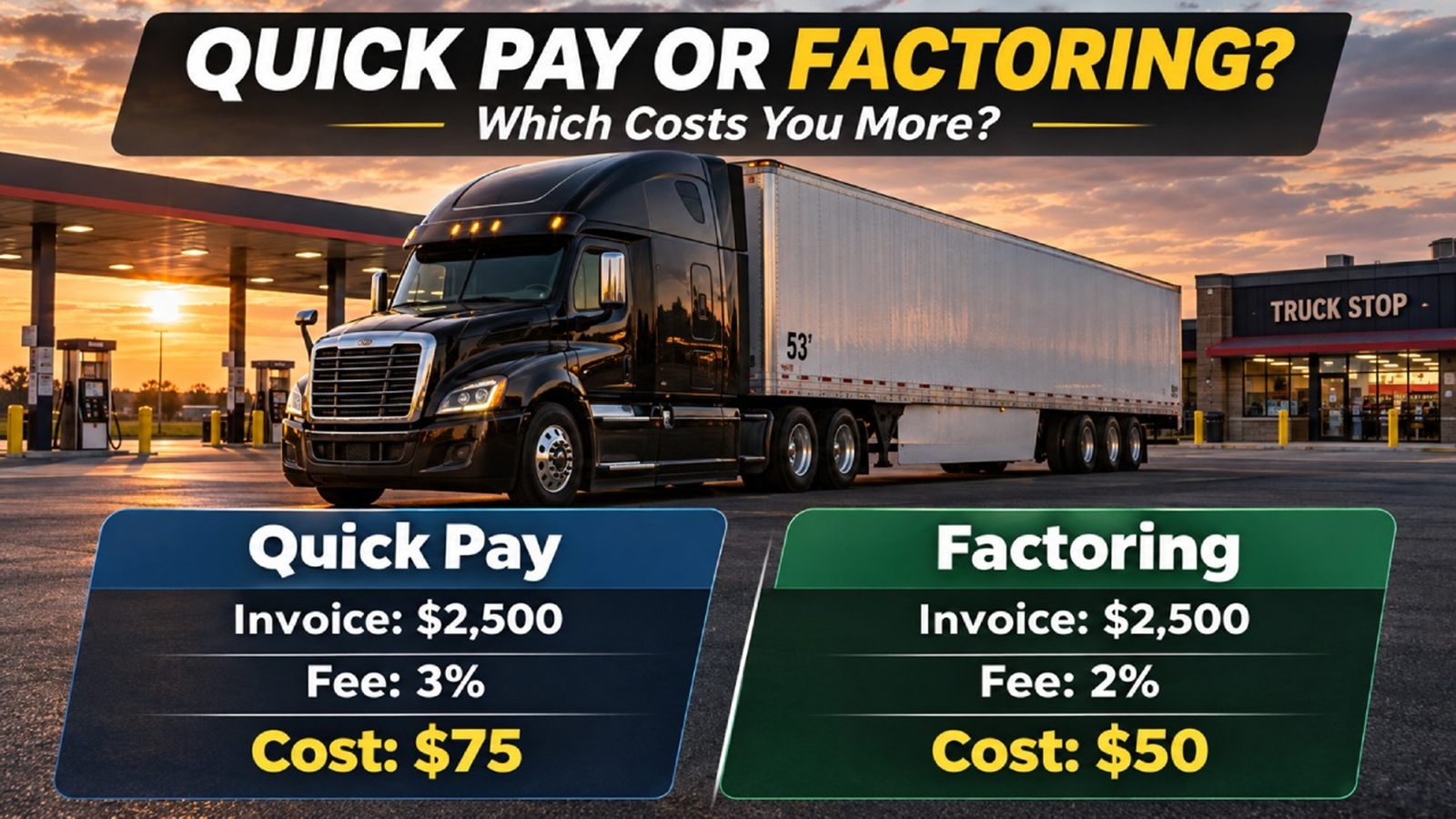
A trucking company bills C$30,000 in a month. It needs early payment on only C$10,000 to cover diesel, insurance and driver wages. A broker offers quick pay at 3%. A factoring company offers a lower rate of 2%.
The factoring offer sounds cheaper. But what if the factoring agreement requires the carrier to finance all C$30,000?
The carrier could end up paying C$600 instead of C$300, despite getting the lower percentage.
For a small fleet, the cheapest financing option isn't necessarily the one with the lowest advertised rate. It's the one that gets enough cash into the bank when it's needed, at the lowest total cost.
What is the difference between quick pay and factoring?
With broker quick pay, a freight broker pays an invoice earlier than its normal payment terms in exchange for a discount. Some brokers allow carriers to select individual invoices for quick pay; others apply the arrangement more broadly.
With freight factoring, a carrier sells its receivables to a factoring company. The factor advances funds against eligible invoices and typically collects payment directly from the broker or shipper.
Factoring may also provide invoice management, collections and customer credit checks. Those services have value, particularly for owner-operators who don't have someone managing accounts receivable.
Both arrangements solve a cash-flow problem. But they don't necessarily solve it at the same cost.
The cost of twelve loads
Consider a hypothetical carrier completing twelve loads in one month, each paying C$2,500.
The carrier invoices C$30,000. Eight invoices have 30-day terms, while four have 60-day terms.
The carrier has enough working capital to wait for payment on eight loads. It only needs the other four paid early to cover immediate expenses.
Assume the carrier receives two offers:
- Broker quick pay at 3%, available on the four selected loads.
- Factoring at 2%, either selectively or under an agreement covering all twelve loads.
Here is what those arrangements cost before additional charges.
| Payment arrangement | Invoices funded early | Total fees |
|---|---|---|
| Quick pay at 3% | 4 | C$300 |
| Selective factoring at 2% | 4 | C$200 |
| Full-volume factoring at 2% | 12 | C$600 |
| Quick pay at 3% | 12 | C$900 |
These rates and arrangements are hypothetical, not advertised market offers. The example assumes a single flat fee for each funded invoice, with no additional charges.
Selective factoring is cheapest in this example, provided the factoring company permits it.
But if the 2% agreement requires all twelve invoices to be factored, the carrier pays C$600. Using quick pay only on the four necessary loads would cost C$300.
That is C$300 spent to receive money earlier on invoices the carrier could already afford to wait for.
The comparison changes if the carrier needs early payment on every load. In that case, 2% factoring costs C$600 compared with C$900 for quick pay at 3%, before other charges.
The first question shouldn't be "Who offers the lowest rate?" It should be "How much money do I actually need early?"
Does a 2% factoring fee always mean 2%?
Not necessarily.
Some factoring agreements charge a fixed percentage. Others increase the fee depending on how long the broker takes to pay.
A carrier quoted 2% should ask whether that rate applies when an invoice is collected after 15, 30 or 60 days.
Additional costs may include setup charges, transfer fees, minimum-volume requirements and early termination penalties.
There is also a difference between the factoring fee and the amount advanced immediately.
Take one C$2,500 invoice with a 3% factoring fee and a 90% advance rate.
| Item | Amount |
|---|---|
| Invoice value | C$2,500 |
| Initial advance (90%) | C$2,250 |
| Reserve withheld | C$250 |
| Factoring fee (3%) | C$75 |
| Remaining reserve released after collection | C$175 |
| Total carrier receives | C$2,425 |
In this simplified example, the carrier eventually receives C$2,425, but only C$2,250 is immediately available.
The C$250 reserve isn't automatically an additional expense. Part of it is returned after the broker pays, subject to the agreement.
For a carrier with a fuel bill due tomorrow, the difference between C$2,250 immediately and C$2,425 eventually matters.
Who takes the loss if the broker doesn't pay?
Getting paid early doesn't necessarily mean transferring all the risk.
Under recourse factoring, the carrier may have to repay or repurchase an invoice if the broker doesn't pay within the agreed period.
Under non-recourse factoring, the factor assumes certain credit risks, but the protection is usually limited to circumstances defined in the contract. A broker's insolvency may be covered, while disputes involving freight damage, shortages or paperwork may not be.
A carrier should ask what happens if a broker refuses payment, not just what happens if the broker goes out of business.
The answer could be more important than a difference of half a percentage point in the fee.
Can you factor only the invoices you choose?
This is one of the most important questions for a small fleet.
Some factoring providers offer selective arrangements. Others require all invoices, or all invoices from particular customers, to be submitted.
An agreement might also impose minimum monthly volumes. A carrier running fewer loads during a slow month could still face charges.
A seemingly inexpensive agreement can become costly if the carrier loses the freedom to decide which invoices need financing.
Before signing, ask whether you can:
- Finance only selected invoices.
- Keep certain brokers outside the factoring arrangement.
- Stop factoring invoices when cash flow improves.
- Leave the agreement without paying a substantial termination fee.
Get the answers in writing. What a salesperson describes as flexible may be narrower in the actual contract.
What happens when you want to leave a factoring company?
Factoring can also change how brokers pay you.
In conventional freight factoring, a Notice of Assignment instructs a broker to direct payments to the factoring company rather than the carrier.
When the carrier ends the factoring relationship, the broker may require a formal release before returning to direct payments.
That means cancelling the factoring agreement doesn't always restore normal payment arrangements immediately.
Before committing, understand the notice period, outstanding balance requirements, termination charges and release process.
The ability to leave is part of the cost of entering.
Could a fuel credit arrangement reduce the need for factoring?
A trucking company's payment problem often starts before the freight invoice is due.
Diesel has to be purchased before delivery. Driver wages, insurance, repairs and other operating expenses cannot always wait 30 or 60 days.
If fuel is the immediate expense, an approved fuel credit arrangement may help bridge part of that gap without requiring the carrier to finance every freight invoice.
But fuel credit has its own repayment terms, limits and possible charges. It doesn't replace working capital needed for wages, repairs and other bills.
A fuel card offering prepaid payments, discounts or credit should therefore be evaluated separately from factoring. The right choice depends on when funds are needed, when payments are due and the total costs involved.
Before signing, compare the money you actually keep
Take your last month's invoices and divide them into two groups: those you could afford to wait for and those you genuinely needed paid early.
Ask the quick-pay provider and factoring company to price those same invoices, including all fees and payment timing.
Then compare the actual amount reaching your bank account before each fuel, payroll and insurance payment becomes due.
A 2% factoring agreement isn't automatically better than 3% quick pay. Nor is quick pay automatically better than factoring.
For a fleet that needs every invoice funded early, comprehensive factoring may offer a better price and useful collection services. For a carrier with reliable brokers and adequate working capital, paying only to accelerate selected invoices may be the better decision.
Don't pay to accelerate C$30,000 in receivables when C$10,000 is all you need. Unless the extra liquidity or services justify the cost, that's money coming directly out of your trucking margin.
About the author
Manpreet Singh
Works with small trucking fleets at ZyloFuel, a Canadian fuel card company for owner-operators and fleets of up to twenty trucks.