Cheaper Fuel Quote Isn't Always Cheaper: Reading Fuel Price Quotes Like a Fleet Owner
A quote that is cheaper at most stops can still cost more if it is pricier where your trucks buy the most diesel.
By Manpreet Singh November 15, 2026 6 min read
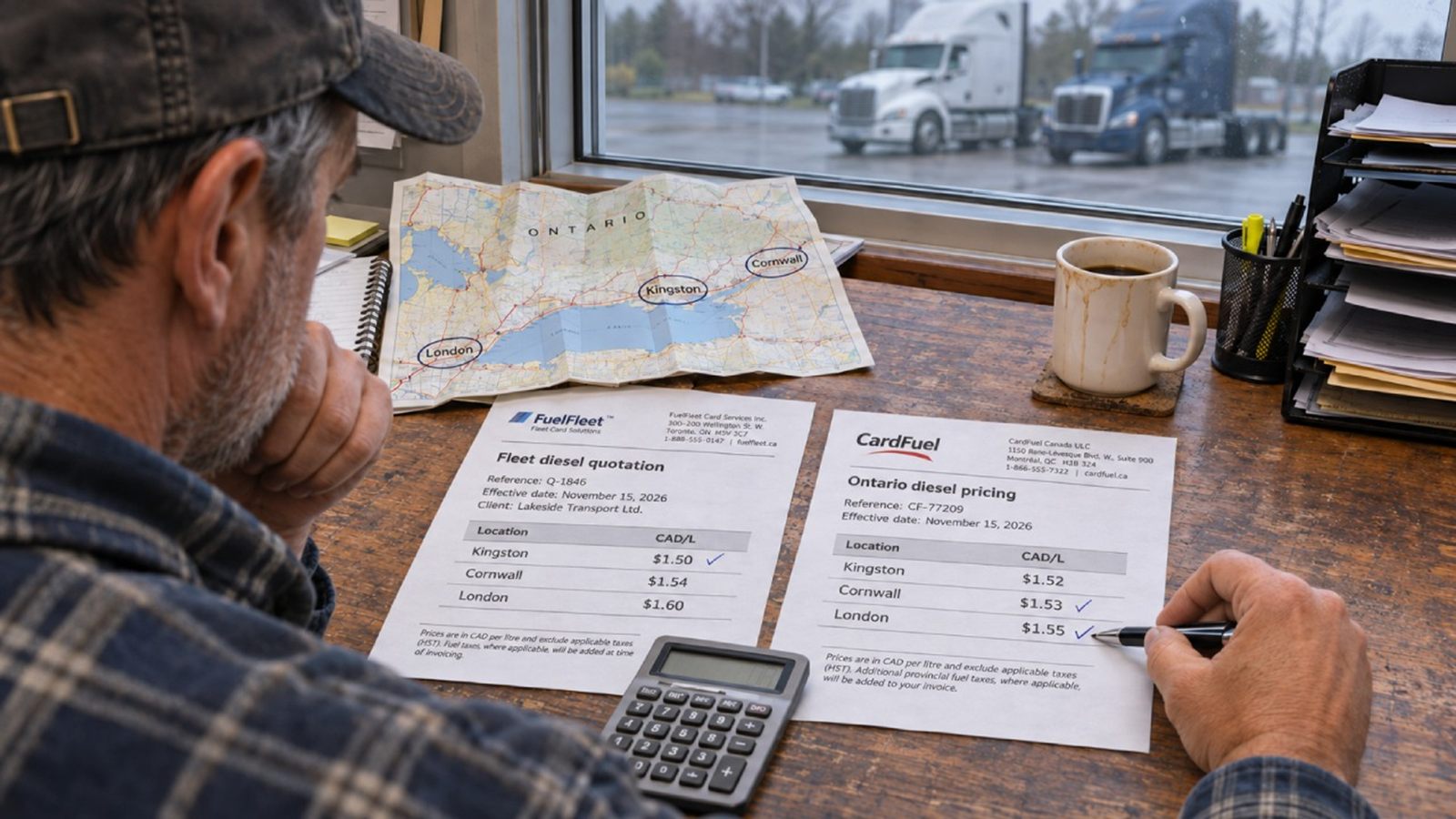
As the owner of a trucking company, how would you compare fuel quotes provided by two fuel card providers? Let me guess. Like most truckers do, you will have a look and will find some truck stops that you recognize and see which one is cheaper.
Suppose I send you a diesel quote this morning. I'm a cent cheaper than your current supplier in Cornwall and five cents cheaper in London. In Kingston, I'm two cents more expensive. Would switching to me save you money? Do your calculations and come on a decision before you read the rest of the article.
Let's convert my offer into dollars first
Say your trucks bought 10,000 litres last month. Here's what those purchases would cost at the two quoted rates. Your current supplier is A. I'm supplier B.
Both quotes are for the same diesel and effective date. The prices are in Canadian dollars per litre, with applicable fuel taxes included and sales taxes excluded. For now, assume neither of us charges fees and the prices are net (i.e., after discounts have been deducted).
| Lane and fuel stop | Monthly litres | A per litre | B per litre | Cost with A | Cost with B |
|---|---|---|---|---|---|
| Toronto-Montreal · Kingston | 6,000 | $1.50 | $1.52 | $9,000 | $9,120 |
| Toronto-Montreal · Cornwall | 3,000 | $1.54 | $1.53 | $4,620 | $4,590 |
| Toronto-Windsor · London | 1,000 | $1.60 | $1.55 | $1,600 | $1,550 |
| Monthly total before sales taxes | 10,000 | $15,220 | $15,260 |
Look at London first. My five-cent advantage saves you $50 on 1,000 litres. Cornwall gets you another $30. So far, my offer puts $80 back in your pocket.
Then you get to Kingston. Your drivers bought 6,000 litres there. The extra two cents I'd charge you would cost $120. Switch your whole fleet to me on these quotes and you'd spend $40 more that month.
Now imagine you've just picked up a Windsor run. Next month, you expect to buy 1,000 fewer litres in Kingston and 1,000 more in London. At these same prices, my quote comes out $30 cheaper. Now think about who's cheaper for you, me or the other fuel card seller.
How would I ask for the quote as a fleet owner?
When it comes to fuel in trucking, even the smallest numbers matter. So getting a quote is not just asking for prices. Here is how I would ask for the quote as the owner of a small fleet.
I will take an ordinary month of diesel purchases and send both suppliers the dates, station addresses and litres. I will keep the number of fills handy while comparing fees. I will give them a straightforward request: "Here's where we fuelled last month and how much we bought. Could you show me what you would have charged for those fills on those dates? Please show sales taxes, fees and any later rebates separately. If you don't cover one of these stops, flag it for me.”
That last line matters. My driver will still need diesel if a station is missing from the quote. I will put in what I'd pay at the backup stop the driver would actually use.
If both suppliers can give me only today's prices, I can still do the calculation above.
When I receive the quotes from both suppliers for last month, the picture will be clear from the totals. It's what last month's litres would cost at today's prices. Petro-Canada sets its published terminal rack prices each business day, so get both quotes for the same effective date. If the gap is as small as $40, I will try the comparison on a few more dates.
This will help me make a very clear decision about which fuel card I will use.
When someone offers you eight cents off, ask “Off what?”
Let's say I offer you 8¢ off the price of $1.65 a litre. You'll pay $1.57. Your current supplier offers only 5¢ off, but their price starts at $1.60. You'll pay $1.55 there. On a 500-litre fill, you'd spend $10 less with your current supplier, so you don't have any reason to change your fuel cards.
If I quote retail minus, ask which pump price I start from at your stop. If I quote rack plus, ask me to name the terminal, the diesel grade and the date of the wholesale price. Then have me show you each amount I add to reach your price at the truck stop. The terminal rack price itself leaves out taxes, retail margins and final delivery costs.
You can even get different pricing rules on the same card. Petro-Canada's SuperPass terms say you pay the pump price less any approved discount at an authorized retail outlet. At a Petro-Pass site, you pay the price Suncor sets for your account at that location. So if I tell you, “Yes, our card works in Kingston,” you still have a good follow-up. “What would you charge me at the Kingston site my driver uses?”
How much of your fuel actually earns the discount?
Here's a real example. In a Shell Canada promotion for eligible OECM customers, the introductory discount was advertised at 8¢ a litre. It applied for four months, covered the first 6,000 litres each month at participating locations, and excluded Shell Flying J sites. The offer listed a 6¢ rate after the promotion and said the discounts would appear on the billing statement.
Imagine your drivers regularly fill up at a Shell Flying J. You could read the headline, do the arithmetic perfectly and still budget for an introductory discount those fills wouldn't earn. Ask your supplier to mark the eligible stops on your list. Then work out a month after the promotion ends. If the quote already shows the discounted price, you've counted the saving once.
Would you send a driver out of the way for this price?
This is a very important question that small fleet owners usually say yes to. But here is a workable example that changes the story.
Say a driver calls you. Diesel is 3¢ cheaper at another stop, and they're about to take on 400 litres. That's $12 in savings. Would you send them there?
If the stop is already on the route, $12 is worth picking up. But say the detour adds 20 kilometres in total. At 35 litres per 100 kilometres, the truck will burn seven extra litres. At $1.50 a litre, that costs $10.50. You're down to $1.50 in savings before you count the driver's time. Your dispatcher and driver can usually tell you which of those two situations you're buying into.
Fees deserve the same quick calculation. Remember the $40 difference between our quotes? Suppose Supplier A also charged $1 per fill. With 50 fills that month, you'd pay $50 in fees and A would end up $10 more expensive. Ask about card and account fees too. If you run into the U.S., get that fee schedule as well. Petro-Canada's SuperPass terms, for example, specify a transaction fee at participating U.S. truck stops.
So don't just compare prices at two truck stops because they look closer on a map. Do the calculations with real numbers.
Ask for an invoice with real numbers
Pick a stop where you buy a lot of diesel and ask, “If my driver bought 500 litres here today, what would I see on the invoice, how much would you debit, and when?” If a rebate comes later, have the supplier show you where it will appear. Get the payment schedule and credit limit in writing. Ask what happens to your discount if a payment is late. Petro-Canada's terms, for example, allow it to reclaim or discontinue discounts in certain overdue-payment circumstances.
Once the first statement arrives, pull a fill from each regular stop and check it against the price for that day. A downloadable transaction report makes this easier. Irving Oil's Fuel Genius, for example, lets you review purchases and export the data to Excel.
If this were your Ontario fleet, I'd start in Kingston. One cent a litre on those 6,000 litres is $60. That one line on your statement is worth more than the entire $40 difference between the quotes.
About the author
Manpreet Singh
Works with small trucking fleets at ZyloFuel, a Canadian fuel card company for owner-operators and fleets of up to twenty trucks.