Made in Canada. Why do US prices still matter for renewable diesel?
Canadian renewable diesel production is growing, but US incentives still shape supply and prices on western trucking lanes.
By Manpreet Singh November 11, 2026 3 min read

Tidewater makes renewable diesel in Prince George, BC. When the company sells that fuel, most of its supply contracts use the price of competing US imports as a benchmark. A litre can be made in BC and sold in BC, and the price of bringing an American litre across the border can still help determine what the producer earns.
For a fleet buying diesel between Edmonton and Vancouver, that explains why a new refinery can give suppliers another place to buy without guaranteeing a lower price at the next fuel stop.
Where Canada’s renewable diesel comes from
Renewable diesel is made by processing fats and oils into a fuel chemically similar to petroleum diesel. Suppliers can sell it on its own or blend it with conventional diesel. Biodiesel is a different product, a distinction worth making if a shipper asks your fleet to use a particular fuel.
In 2024, Canada imported an estimated 1.3 billion litres of renewable diesel from the US. Canadian plants produced 687 million litres that year, and Canada exported 450 million litres. Fuel was already moving both ways across the border.
Since then, Canadian buyers have gained another source. In August 2025, Imperial announced that its Strathcona refinery near Edmonton was supplying renewable diesel to western Canadian customers. Its stated capacity is up to 20,000 barrels a day. In Newfoundland and Labrador, Braya reached a different milestone. Its Come By Chance refinery was already producing renewable diesel when it announced its first sale for the Canadian market in June 2026. A Canadian customer bought 100,000 barrels.
How the US market reaches Prince George
Consider the purchase from a fuel supplier’s side. If the supplier can bring renewable diesel in from the US, the cost of getting it here gives the supplier a price to compare with a Canadian offer. That is what import parity means in Tidewater’s contracts. The American fuel can influence a deal even when the buyer takes delivery from Prince George.
That gives Canadian buyers a reason to watch US policy. In 2025, the US shifted a federal tax credit from blending fuel to producing it domestically. Under the 2026 rules, Canadian-grown canola can qualify as a feedstock when the fuel is made in the US. Fuel made from the same canola in Alberta or BC falls outside that US production credit. The rules change the economics on one side of the border. Tidewater’s contracts show how prices on that side can matter on this one.
Canada is backing its own producers. Ottawa’s Biofuels Production Incentive offers per-litre support for eligible production in 2026 and 2027. A separate federal proposal published October 31 would give qualifying Canadian-made renewable diesel 1.5 times the usual compliance credits. As of November 10, 2026, that proposal was still open for comment.
What’s in the tank on an Alberta–BC run?
BC requires fuel suppliers to meet an 8% renewable fuel target in the diesel category. Since April 2025, the eligible fuel counted toward that target must be made in Canada. Alberta requires an annual average of 2% bio-based diesel. Those percentages apply across a supplier’s sales. A driver filling up in Kamloops cannot use the BC figure to tell a shipper exactly how much renewable diesel went into the truck.
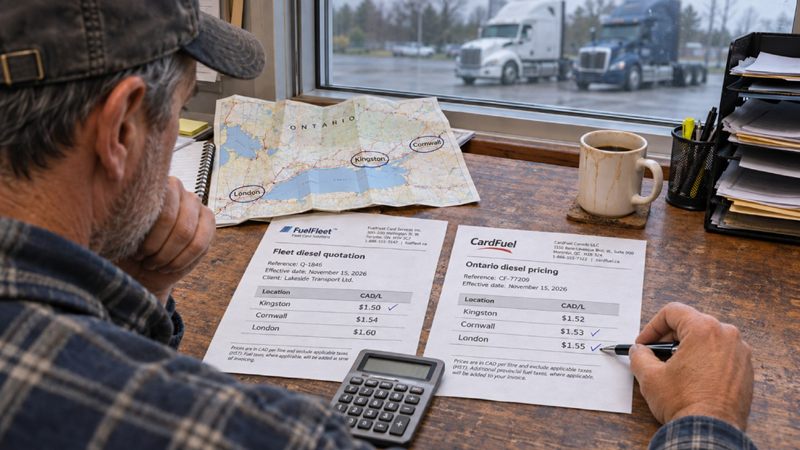
If price is the reason you’re choosing a stop, compare the quotes your fleet can actually buy at along the route. If a shipper requires renewable diesel, dispatch has a different call to make before the truck leaves. Ask your supplier, “Which of our regular stops carries the blend the customer asked for? What will the receipt or delivery record show? And if that stop runs out, where else can we send the driver?”
About the author
Manpreet Singh
Works with small trucking fleets at ZyloFuel, a Canadian fuel card company for owner-operators and fleets of up to twenty trucks.