CNG trucks in Canada: working out the fuel gap per kilometre
How to turn a US natural gas price gap into cents per kilometre, what CNG tanks cost you in payload, and where Canadian trucks can fill.
By Manpreet Singh October 24, 2026 5 min read
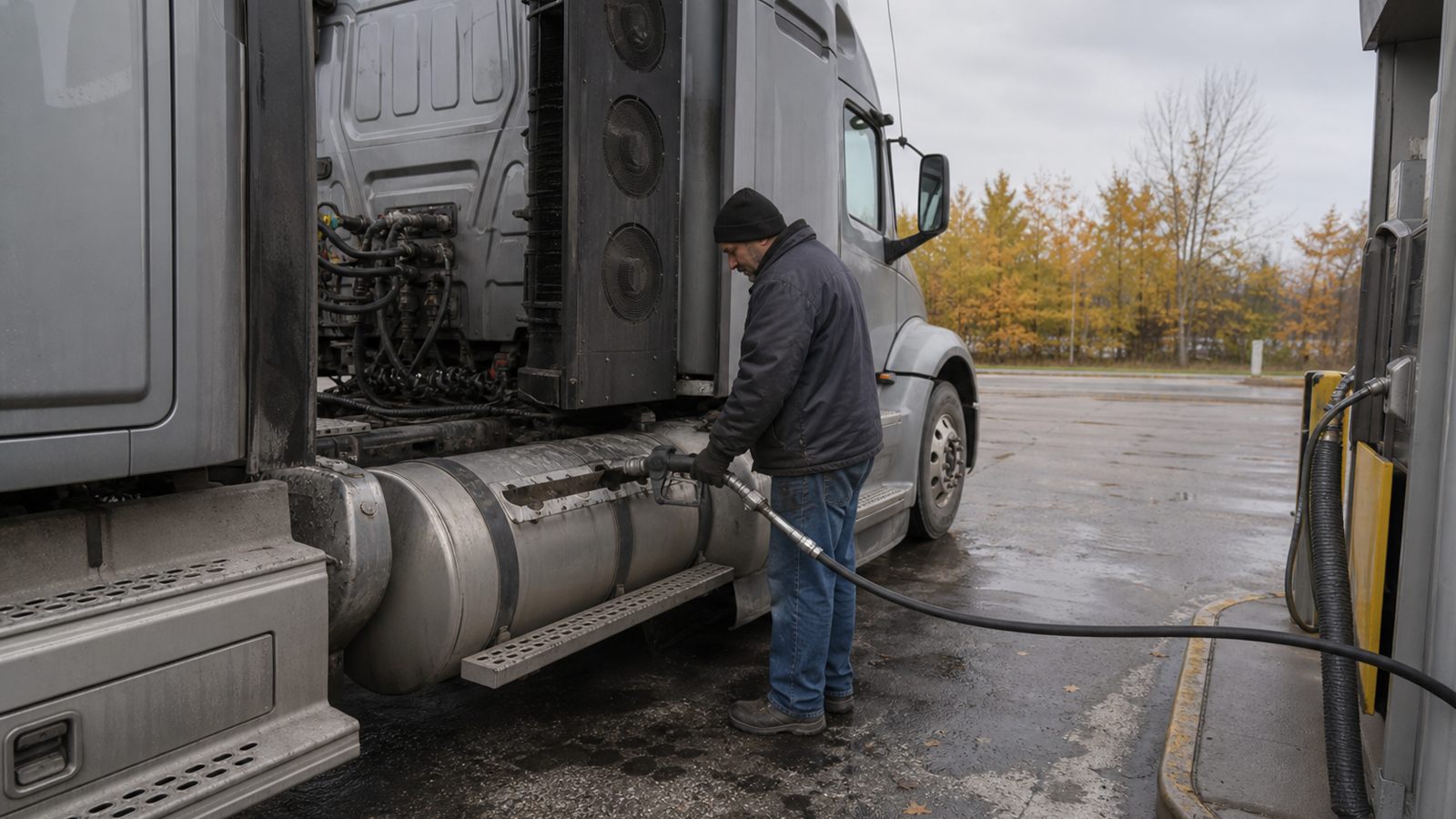
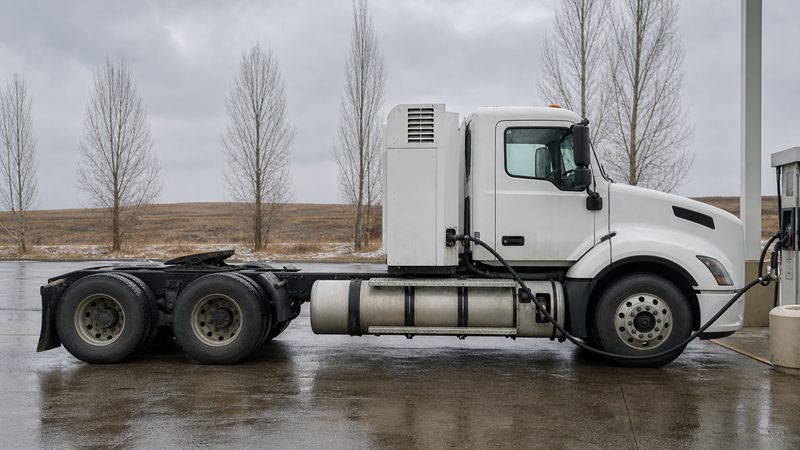
In mid-October 2026, Hexagon Agility parked a natural gas demonstration truck outside the American Trucking Associations' show in Charlotte, N.C. A decal on its side put a dollar figure on how much less gas costs than diesel per gallon. Ian MacDonald, the company's senior vice president of sales for the Americas, told trucknews.com the decal was already out of date, because the diesel price spike had pushed the gap wider since it was printed.
That's a US gap, in US dollars per US gallon, at US pumps. If you're pricing a tractor in Ontario or Quebec you need it in litres and kilometres, and then you have to set it against what the gas truck costs extra and what its tanks stop you hauling.
Turning the price gap into cents per kilometre
The fuel saving on a kilometre comes from two numbers multiplied together: the gap between diesel and gas per diesel-equivalent litre at the pump you'd actually use, and the litres your truck burns per kilometre. Get the first from the station you'd fill at, not from a US headline. It moves every time diesel does.
For the second number, Energy Vision, a US non-profit, uses a tractor averaging 6 miles per diesel gallon equivalent (DGE) in the September 2026 figures Heavy Duty Trucking reported. Six miles per DGE is 9.66 km, or about 39 litres per 100 km in diesel terms. They count the whole price gap per DGE as savings, which treats the gas truck as using as much energy as the diesel would.
Energy Vision puts the extra cost of a new Class 8 natural gas tractor with a Cummins X15N at about $75,000 US over a comparable diesel. Break-even in kilometres is that premium divided by your saving per kilometre. The report also works out payback in years for trucks running 80,000 and 100,000 miles a year, and since it uses the same method, read those as a best case for a truck that only ever fills on gas. To do it in Canadian money, take the dealer's premium in dollars and divide it by the station's gap per diesel-equivalent litre times the litres you burn per kilometre. Write the answer down, then do it again with last spring's gap, because you'll be paying the truck off through both.
Two things push that number further out. First, the 7.7 miles per DGE MacDonald quoted came from a high-utilization fleet demo in the Midwest. If the diesel you'd otherwise buy is just as frugal, both trucks burn less per kilometre, the same gap is worth less on every kilometre, and break-even moves further away. Second, Energy Vision says its estimate leaves out financing, maintenance, fuelling infrastructure and resale value. Your banker and your shop will have opinions on all four.
What the tanks cost you in payload
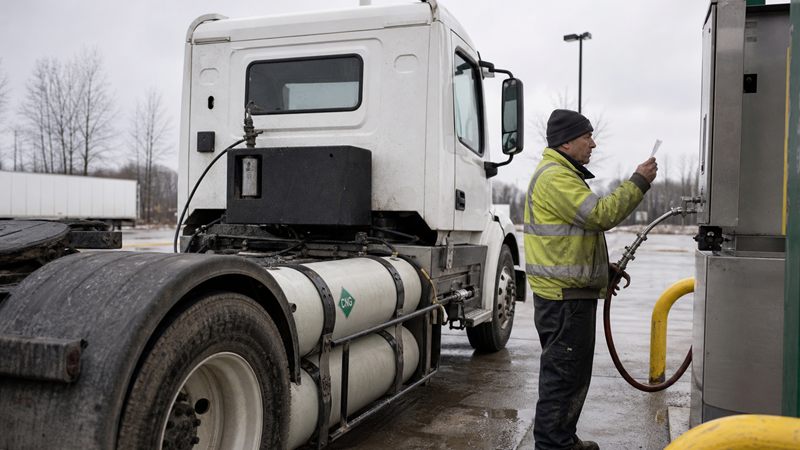
According to Hexagon Agility's published specs, as trucknews.com tallied them, the demo truck has one back-of-cab system and two frame-rail systems holding 265 DGE. They weigh about 1,470 kg empty and 2,227 kg full. MacDonald added that the natural gas engine package is about 227 kg lighter than a comparable diesel powertrain, partly because the aftertreatment is simpler. That leaves the gas truck roughly 1,240 kg heavier with empty tanks and about 2,000 kg heavier full. Those figures don't subtract a diesel tractor's own tanks and fuel, which would win some of it back.
If you cube out or run light, none of this matters. If you scale out on every load, it's a tonne or more of freight left on the dock every trip. Price that at what you're paid per tonne and add it to the gas truck's cost per kilometre before you work out break-even. MacDonald says Hexagon's customers have generally still carried the payloads they need. He also says heavy Canadian work at 54,400 to 59,000 kg gross shows a smaller fuel economy gap against diesel.
It only pays where you can fill
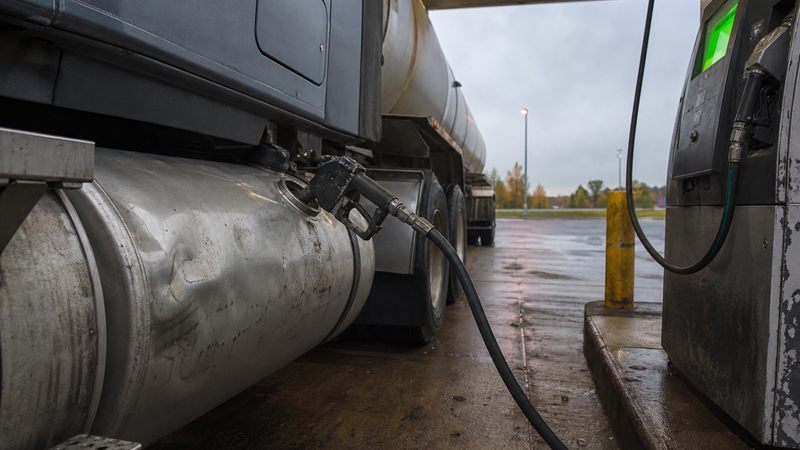
The demo truck is advertised at more than 1,930 km of range, and MacDonald says it can top 2,170 km at the mileage it's been getting. That's a long leash, but every one of those kilometres starts at a CNG pump, and break-even only counts kilometres actually run on gas.
Énergir's list of public natural gas stations has eleven, all in Quebec. They run from Love's at Coteau-du-Lac near the Ontario line to Montreal, Trois-Rivières, Lévis, Sherbrooke, Chicoutimi and St-Félicien. MacDonald points to that network, and to Quebec dealers who put demo trucks in fleets' hands, as the reason the province is coming back to gas even though the Écocamionnage incentive is gone. In Alberta, Clean Energy and Tourmaline opened a CNG station in the Edmonton area in April 2023 and stations in Calgary and Grande Prairie in October 2024. A truck running Montreal to Quebec City, or Edmonton to Calgary, every day can rack up gas kilometres fast enough for the math to work.
Ontario is thinner. In December 2018, Union Gas's energy services affiliate and Clean Energy opened CNG at three 401 truck stops: the Husky Travel Centre in Windsor, the Flying J between London and Woodstock, and the Flying J at Napanee. None of the sources here shows a public station on the 400 or 11/17 or anywhere off the 401, and they don't say whether all three 401 sites are still selling gas in October 2026. A small Ontario fleet takes loads wherever they go, and on many of those lanes a CNG truck would sit the load out. A truck that can only take some of your loads takes a long time to reach break-even on gas kilometres.
One thing may narrow the gap. MacDonald says US fleets have been buying diesels built to today's emissions rules before possibly pricier EPA 2027 engines arrive. If next year's diesel tractors cost more, the gas premium shrinks. How that shows up on a Canadian quote is a question for your dealer.
Before you ask a dealer to refresh a quote for a truck based in Ontario, call the Flying J at Napanee. Ask whether it still sells CNG, and at what price.
About the author
Manpreet Singh
Works with small trucking fleets at ZyloFuel, a Canadian fuel card company for owner-operators and fleets of up to twenty trucks.