Natural gas trucks: range, power, winter and payload, checked
Which old objections to natural gas trucks the 15-litre engine has answered, and which two (tank weight and fuelling) still hold for Canadian carriers.
By Manpreet Singh October 24, 2026 2 min read
Most of what carriers wrote off about natural gas trucks was true of the old 12-litre engine, and isn't true of the 15-litre that replaced it. Two objections still stand. The tanks are heavy, and outside a few corridors there's nowhere public to fill.
Power was the real problem. Cummins' ISX12 G made 400 hp and 1,450 lb-ft, which Jim Park wrote in Truck News wasn't enough for most Canadian work. The X15N goes up to 500 hp and 1,850 lb-ft, and it already has 1,700 lb-ft at 900 rpm. In October 2026 Ian MacDonald of Hexagon Agility told trucknews.com that the trucks are pulling long combination vehicles in Canada and running at gross weights of 54,400 to 59,000 kg, and that in this heavy work the fuel economy gap against diesel gets smaller. The one weaker spot Park found was the engine brake, at about 460 braking hp against roughly 525 on the X15 diesel.
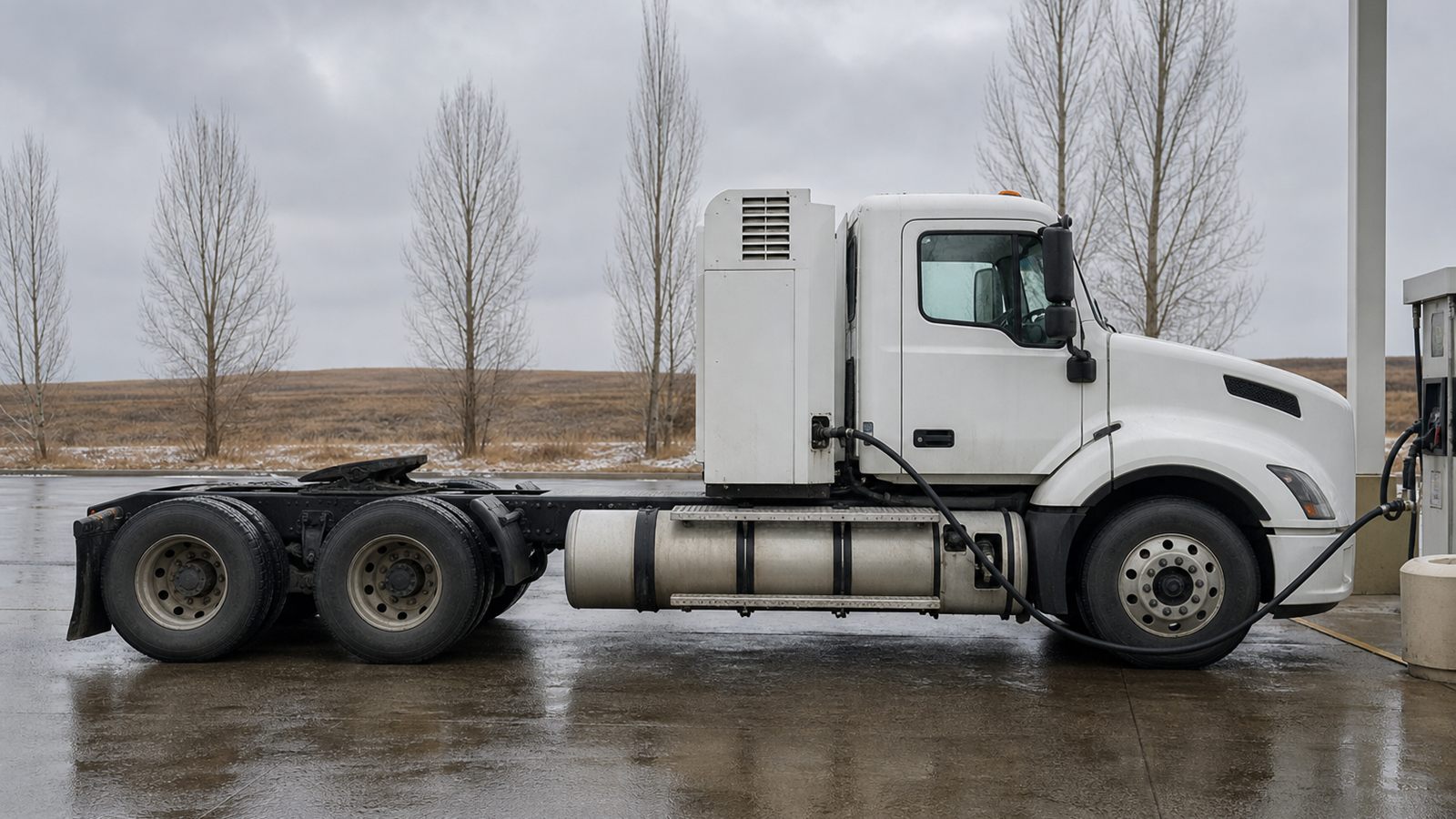
Range comes down to how much tank you spec. Hexagon's demonstration truck carries 265 diesel gallon equivalents (DGE) and is advertised at more than 1,930 km. MacDonald says it averaged 7.7 miles per DGE in a Midwest fleet trial, which would take it past 2,170 km. A 175 DGE back-of-cab system is good for about 1,290 km, but people tend to miss that this figure assumes an eight-hour slow fill. Park notes that a 15-minute fast fill gets you about 20 per cent less.
On safety, the U.S. Department of Energy's Alternative Fuels Data Center says leaking CNG is lighter than air and disperses outdoors. The danger is gas collecting in an enclosed space such as a shop. After any real hit, a CSA Group or NGVI-certified inspector has to check the tanks before the truck goes back out.
Winter is less of a question than it was. The X15N's North American field testing included cold-weather running, and two of the 16 test fleets were Canadian. The engine uses a three-way catalyst with no DEF at all. Quebec fleets ran the 12-litre for years, and MacDonald says dealers there, including Excellence Peterbilt and Globocam, are putting demo trucks in carriers' hands again.
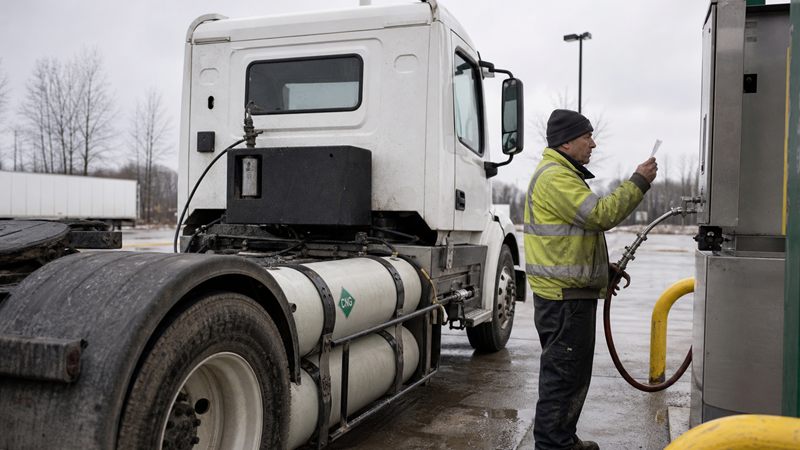
The weight problem is real. By Hexagon's published specs, the tanks on that demo truck weigh about 1,470 kg empty and 2,227 kg full. MacDonald says the gas engine package is about 227 kg lighter than a comparable diesel, partly because the aftertreatment is simpler. That makes the net penalty smaller than the tank weight alone, but on a load that already scales out it still matters.
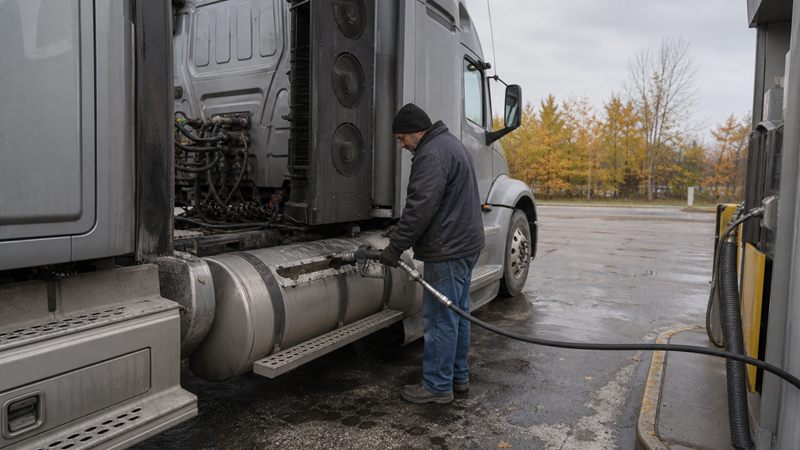
The fuelling problem is real too. Clean Energy says it owns or runs dozens of stations in Canada, but many of them are private. With Tourmaline it plans up to 20 public CNG stations along Western Canada highway corridors. As of October 2026 its Canada page says three are open, and Clean Energy lists them in Edmonton, Calgary and Grande Prairie. If your lanes don't pass a public station you can count on, the engine's numbers won't help you.
About the author
Manpreet Singh
Works with small trucking fleets at ZyloFuel, a Canadian fuel card company for owner-operators and fleets of up to twenty trucks.